Published by Sue Johns-Chapman
Published Date 16.04.2026
Published by Sue Johns-Chapman
Published Date 16.04.2026 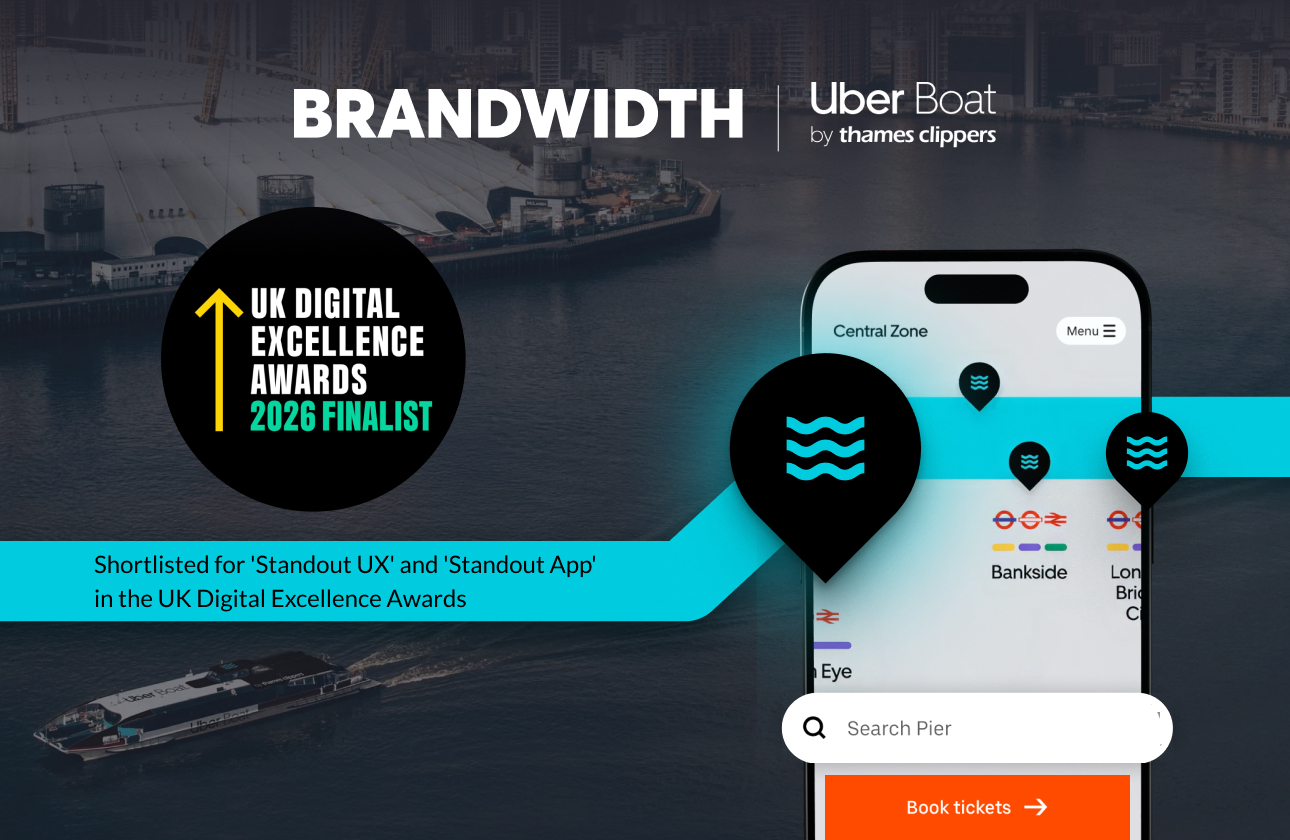
Most transport apps help you buy a ticket. Very few help you understand the journey.
That was the starting point for Brandwidth’s work with Uber Boat by Thames Clippers (UBTC). Together, we set out to transform a ticket-only app into a data-led transport platform that could drive revenue, improve passenger confidence and unlock commercial insight.
We’re proud that this work has been shortlisted at the UK Digital Excellence Awards in two categories, Standout UX and Standout App. In this article, we share how we approached the challenge, what we built, and what this recognition means to the team behind it.
About Brandwidth
Brandwidth is a digital customer experience agency with over 20 years of experience designing and building digital products. We work across customer experience and technology, content and social, commerce and performance, combining strategy, design and technology to solve complex business problems. But we don’t start with the product. We start with the problem, and often, it is not the one written in the brief.
Our role is to understand what a business is really trying to achieve, then shape the systems, journeys and decisions needed to get there. That often means challenging the brief itself, not just delivering against it. From digital platforms and content ecosystems to performance marketing and optimisation, we focus on what will drive meaningful change. That means challenging assumptions, not just delivering requirements, so what we create does more than work well. It moves the business forward.
About Uber Boat by Thames Clippers
Uber Boat by Thames Clippers is a long-established river transport operator, running high-frequency services across London via the Thames. Over the past 25 years, the business has played a central role in developing the river as a viable part of the city’s transport infrastructure.
Today, its River Bus service spans 24 piers, forming one of the most extensive commuter river networks in Europe. The operation sits at the intersection of transport, infrastructure and city planning, supporting movement across key residential, commercial and cultural areas.
Alongside this, the business has continued to invest in the future of river travel, from exploring hybrid and hydrogen-powered vessels to securing government funding to support more sustainable marine technology. This long-term focus reflects a broader ambition to ensure the Thames remains an active, evolving part of London’s transport network.
A service that needed more than an update
Until recently, their digital experience did not reflect the scale or ambition of the service. The previous app handled ticket bookings and displayed static timetable information. Passengers could buy a ticket, but they could not confidently plan, track or understand their journey. Instead, they were forced to piece together static timetables, websites and signage, none of which reconciled live vessel data, river conditions or capacity. This created high uncertainty, missed boats and no single place to plan or track river journeys.
The business didn’t need a better version of the same app. It needed something fundamentally different.
The brief behind the brief
Working closely with UBTC from the outset, we focused on the commercial challenge behind the product. The goal was to grow passenger numbers, improve reputation, and make river travel a default choice for commuters and tourists.
That required more than a booking tool. The app needed to make the river visible in real time and journeys predictable, so it could become a trusted part of London’s transport network.
From there, the objective was clear. Bring together planning, payment and live tracking into one seamless experience. One that supports commuters who need speed and reliability, and tourists who need clarity and confidence.
The brief was built on a three-to-five-year time horizon for how the service should evolve.
Building the data layer first
Before any design work began, we had to solve the data first.
The Thames doesn’t behave like a road. Vessels do not follow fixed lanes. Currents and tides change constantly, and GPS is less reliable on water. This means that tracking a boat is far more complex than tracking a car. Real-time accuracy is harder to achieve, and without it, the experience falls apart.
To make this work, we brought together multiple sources of operational data into a single, coherent view of the river. That meant understanding how boats move, how conditions change, and how that affects arrival times and capacity. Only then could we make that information reliable enough for people to trust.
This became the foundation of the app’s core feature: “Where’s My Clipper”. If a passenger can trust that the information on screen reflects reality, they can plan their journey with confidence. Getting this right was technically demanding and required close collaboration with UBTC’s IT and marketing teams throughout.
“This app is a huge leap forward for our customers. Brandwidth helped us reimagine the travel experience, blending intuitive design with advanced features like ‘Where’s My Clipper?’ It’s a perfect example of customer-centric innovation, executed with precision.”
Adrian White, Head of Marketing and Communications at Uber Boat by Thames Clippers.

Layers of useful experience
Once the data foundation was in place, we could build something people would actually use.
The app now brings together live boat tracking, real-time updates and capacity indicators so passengers can see how busy their boat is before it arrives. Tourists can orient themselves along the river, with landmark information to help them navigate between piers. Food and drink ordering on board is available in-app. iOS and Android versions are developed in parallel, so every passenger receives the same experience regardless of their device.
The design challenge was significant. Fitting that volume of information and functionality into a mobile screen, clearly and intuitively, required rigorous UX and UI thinking. The result is an app that feels clear, useful and dependable. One that fits naturally into how people move around London.
Results that speak plainly
We track what matters. Downloads and revenue are the headline metrics, and both saw a sharp increase following the app’s launch. Year-on-year comparisons show meaningful growth in the number of people downloading and repeatedly using the app.
In-app ticket purchasing and mobile payments have also increased significantly, while repeat usage is strong and ratings have improved. More importantly, we’re now seeing behavioural data that simply didn’t exist before. That means that UBTC can better understand how people actually use the river, not just how they buy a ticket.

What Being Shortlisted Means to Us
Being shortlisted is validation for the team that goes beyond the metrics.
From the conceptual work around rethinking the service architecture, to the challenge of making complex, real-time data genuinely useful for people, this was a deeply considered project from the start. Long before design began, there was a huge amount of thinking around how the service should work across both Uber Boat by Thames Clippers and Brandwidth, and how it could be delivered in a way that improves decision-making for users.
It also recognises the scale of the challenge. From integrating multiple data sources on the backend, to solving how an entire live river network fits into a clear, usable mobile experience, every part of the project required careful design and collaboration. The result is something we’re proud of, not just because of the early success, but because of how well both teams worked together to make it happen.
For us, the shortlisting shows that this work is not only delivering results but is recognised by peers who understand the level of thinking, craft and effort behind it.
We’re looking forward to the awards and proud to see this project recognised alongside some of the best digital work in the UK right now.
To find out more about our work, visit Brandwidth or follow us on LinkedIn.